Research Prototype

Constraint-based visualisation for ICU clinical decision support

A modern ICU patient generates more streams of monitored data than any clinician can continuously integrate. The Critical Care State Space Project addresses this directly with visual models that compress a defined domain of ICU physiology into a single evidence-anchored view, making the dominant clinical problem immediately visible.
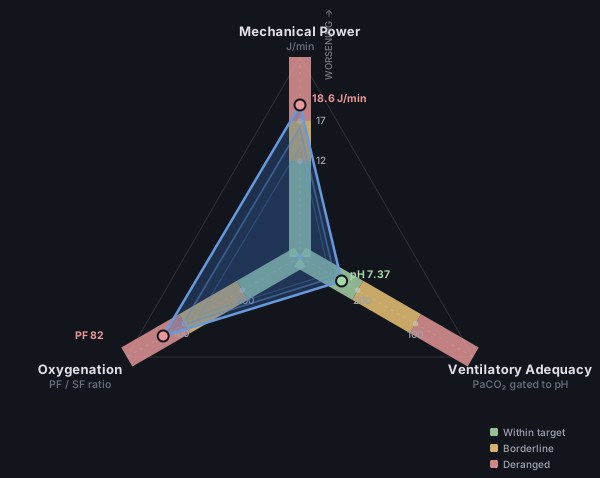
Ventilation Constraint Model — example deranged state showing elevated mechanical power and impaired oxygenation

Prototypes

These are constraint-state-space visualisation models, not dashboards. Where a dashboard presents data, these models represent the patient's state within a defined physiological constraint space potentially opening new ways of understanding a patient's physiological condition.

Two live interpreters are available below. Both implement manual scrubbing of a 24-hour temporal loop to readily appreciate trajectory, hourly quantisation of blood-gas-derived values, and a "worst-metric" composite highlight that makes the dominant constraint readily visible.

Prototype I
Ventilation Constraint Model

A three-axis polygon spanning mechanical power, oxygenation, and ventilation, with a parallel "drill-down" view for resistance, PEEP, and compliance (the key mechanical determinants). A dedicated dead-space panel grounded in the Enghoff modification of the Bohr equation surfaces the P(a−ET)CO₂ gradient and Vd/Vt as a differential-reasoning cue.

Mechanical power Oxygenation Dead space Vd/Vt Simulate mode
Open prototype
In development
Prototype II
CRRT Constraint Interpreter

Extends the paradigm to continuous renal replacement therapy as a four-axis polygon covering volume balance, metabolic state, hemodynamic adequacy, and solute clearance. A circuit-and-filter schematic view offers a complementary spatial reading of filter health, anticoagulation adequacy, and transmembrane pressure.

Volume balance Metabolic state Solute clearance Circuit health Citrate
Open prototype

Research prototypes only. The interpreters are intended for educational and methodological exploration. They are not validated clinical decision-support systems, are not regulated as medical devices, and are not intended to substitute for clinical judgement. Methodological documentation is available under Approach; the conceptual references are listed under References.